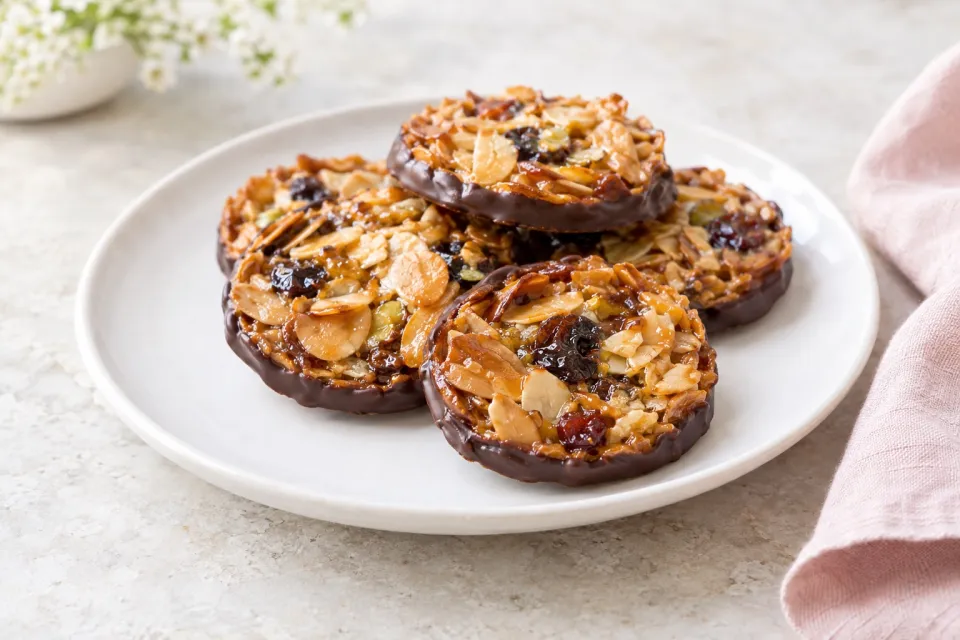
Chocolate Florentine Cookies
Crisp almond-cocoa cookies are paired with dark chocolate for a delicate, buttery bite with a little crunch.
Prep 2 hr 30 min · Cook 15 min · Total 3 hr 50 min · Makes about 90 sandwich cookies
Ingredients
- 2 1/2 cups slivered almonds
- 1/4 cup all-purpose flour
- 2 tablespoons natural cocoa powder, not Dutch-process
- 1/4 teaspoon ground nutmeg, optional but recommended
- 3/4 cup white granulated sugar
- 1/2 cup unsalted butter
- 1/4 cup heavy cream
- 2 tablespoon honey
- 1 teaspoon vanilla extract
- 8 to 10 ounces of dark chocolate, chopped
Directions
- Add the slivered almonds to the bowl of a food processor and pulse until they break into small pieces, about 1/4 inch across. They should look like finely chopped toppings for ice cream. If you do not have a food processor, chop the almonds with a knife, or put them into a ziplock bag and use a wooden rolling pin to crush them to that same size. Sprinkle in the flour and cocoa powder, then give the processor a couple of pulses to combine everything.
- Put the sugar, butter, cream, and honey in a medium-sized saucepan. Warm the mixture until the butter has melted and the sugar has dissolved. Take the pan off the heat, then mix in the vanilla extract. Stir in the almond mixture until it is fully incorporated. Set the saucepan aside for 20 minutes so the batter can cool.
- Heat the oven to 325ºF. Cover a baking sheet with a silicon baking mat or a piece of parchment paper.
- After the resting time, the batter should still feel warm. Scoop it onto the prepared sheet with a teaspoon measure, using 1 teaspoon per cookie. Leave about 3 inches of room between scoops, since they spread generously as they bake. A 12 x 18 sheet should comfortably hold 6 cookies.
- Dip a fingertip in water, then gently spread each portion into a round, keeping the nuts in a single layer against the pan. That little nudge helps the batter spread into an even circle.
- Slide the pan into the oven; the cookies need 6 to 8 minutes. Parchment paper tends to make them bake faster. A silicon baking sheet insulates them from the heat, so they may need a little longer, though they will bake more evenly. Remove the pan as soon as the edges begin to brown and darken, and place it on a cooling rack. Stay close here; these can move from done to burnt quickly.
- While the cookies are still hot, check their shapes. If any are a little wonky, use a spatula to coax the sides back into rounds. Work quickly, because the cookies stiffen as they cool.
- Allow 10 to 20 minutes for the cookies to set on the pan. They can be slightly soft, but you should be able to move each one whole, without tearing it or making ripples. A very thin, flat spatula helps, since it can slip under the cookies cleanly. If you have a wire rack with crisscross wires, choose it for these; a slightly under-baked cookie can sag on racks where the wires sit farther apart. Cool them completely.
- Repeat the scooping, shaping, baking, and cooling with the remaining batter until none is left.
- After all the cookies have baked and cooled, put the dark chocolate in a microwave-safe bowl and melt it in 30 second increments, stirring after each round. If you would rather use a double boiler, that works too.
- Match 2 cookies that are close in size. Spread a thin layer of chocolate onto the underside of one cookie, top it with the other cookie's bottom side, and move the sandwich to a parchment-lined baking sheet or a wire rack.
- Do the same with the rest of the cookies, then drizzle any leftover chocolate over the Florentines.
- Before serving or packaging, let the chocolate set completely. The cookies can sit in an airtight container at room temperature for 3 days; in the refrigerator, plan on about 2 weeks.