Coconut Cake with Lemon Curd and Vanilla Buttercream
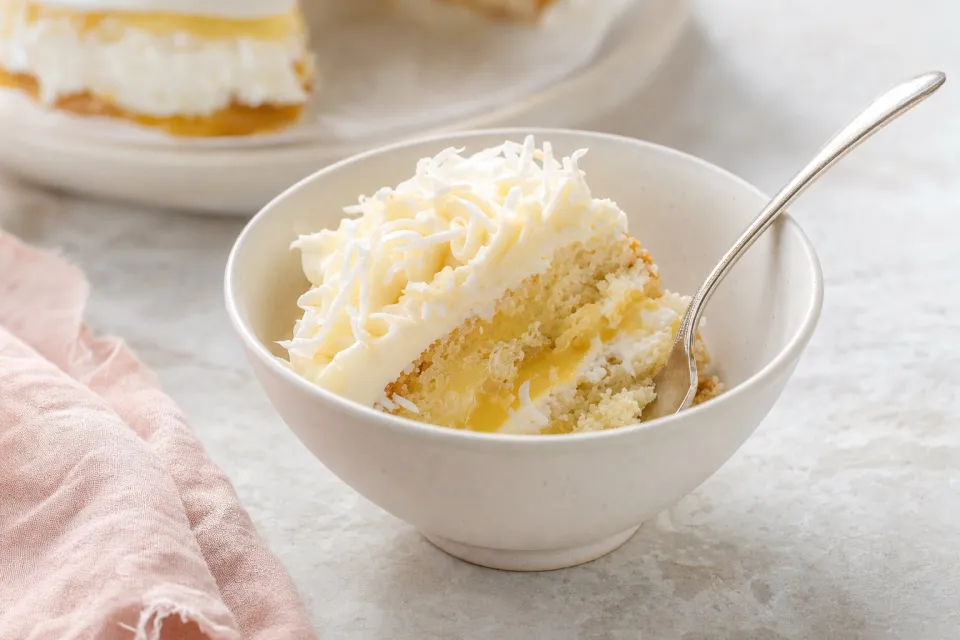
Tender coconut layer cake with tart lemon curd, silky vanilla buttercream, and a snowy coating of chewy shredded and crisp toasted coconut.
Prep 1 hr 50 min · Cook 45 min · Total 5 hr 50 min · Makes 1 9-inch layer cake (8 slices)
Ingredients
- Butter
- Flour
- 2 3/4 cups all-purpose flour
- 1 teaspoon baking powder
- 1/2 teaspoon baking soda
- 1/2 teaspoon salt
- 4 large eggs
- 1/2 cup unsalted butter, at room temperature
- 1/2 cup coconut oil
- 1 1/2 cups sugar
- 1 cup canned cream of coconut, such as Coco Lopez
- 1 teaspoon vanilla extract
- 1 cup buttermilk
- Pinch of salt
- 1 tablespoon finely grated lemon zest
- 1/2 cup lemon juice
- 3/4 cup sugar
- 2 large eggs
- 2 egg yolks
- 6 tablespoons unsalted butter, cut in small cubes
- 3/4 pound cold unsalted butter, cut into pieces
- 4 egg whites
- 1 cup sugar
- 1 1/2 teaspoons vanilla extract
- 1 cup unsweetened coconut flakes, toasted
- 1 cup lemon curd
- 1 cup shredded unsweetened coconut
Directions
- For the cake, which gives you 2 9-inch rounds, start by heating the oven to 350F. Butter 2 9-inch round layer cake pans, coat them with flour, and knock out anything extra. Fit a round of parchment paper into the bottom of each pan.
- In a bowl, whisk together the flour, baking powder, baking soda, and salt until everything is evenly mixed.
- Separate the eggs, putting the yolks in one bowl and the whites in another. Tuck the egg whites into the refrigerator until you need them.
- In an electric mixer fitted with the paddle attachment, beat the butter and coconut oil on medium speed for 3 minutes. Add the sugar and keep beating for 2 minutes; this is where you build a little air into the batter, so don’t rush it. Turn the mixer to low and add the egg yolks one at a time, mixing just until each one is worked in. Mix in the cream of coconut and vanilla.
- With the mixer on its lowest speed, add 1/3 of the dry mixture, then half of the buttermilk. Mix only until combined, then scrape down the bowl. Add another 1/3 of the dry mixture, followed by the rest of the buttermilk. Scrape down the sides again, then mix in the final 1/3 of the dry mixture.
- Take the bowl off the mixer stand and scrape the batter into a large bowl.
- Wash the mixer bowl well with dish soap, making sure there’s no fat left behind, and dry it completely.
- Using the clean bowl and the whisk attachment, beat the egg whites with the salt on medium high speed until the whites are stiff but still creamy. They should hold peaks without looking dry; if they begin to look crumbly, stop right there and move on.
- Spoon 1/3 of the beaten egg whites onto the cake batter and gently mix them in to loosen the batter. Add the rest of the egg whites and fold them in carefully. To fold, slide your spatula down into the bowl, lift the batter up, and turn it over onto itself; rotate the bowl a bit and keep going until you no longer see streaks of egg white.
- Divide the batter evenly between the prepared pans and smooth the tops with the back of a spoon.
- Bake the cakes for 30 to 35 minutes, until a skewer inserted in the center comes out clean. The cakes should also be just starting to pull away from the sides of the pans.
- Set the pans on a wire rack and let the cakes cool for 10 minutes. Gently turn them out onto another rack, then turn them over again so they are right-side up. Let them cool completely, then peel off the parchment paper before assembling the cake.
- You can bake the cake layers 1 day or 2 ahead of assembly. Let them cool all the way, wrap them in aluminum foil, and refrigerate until you’re ready for them.
- For the lemon curd filling, which makes 1 1/4 cups, place a strainer over a bowl and keep it right beside the stove before you begin.
- In a heavy bottomed medium saucepan, whisk together the lemon zest, lemon juice, sugar, eggs, egg yolks, and salt. Add the pieces of butter.
- Set the saucepan over medium heat and cook, stirring the whole time with a spatula, for 5 to 6 minutes. The curd is ready when it thickens and just begins to bubble around the edges, or reaches 170F on a thermometer.
- Immediately take the pan off the heat and scrape the curd into the strainer. Press it through with your spatula, then refrigerate for 1 to 2 hours, until cold.
- Once made, the lemon curd can stay refrigerated for several days. This recipe makes a little more than you’ll need; the extra can go on toast or be sandwiched between cookies.
- For the buttercream, which makes about 4 cups, enough for the top and sides of a 9-inch layer cake, start with the butter. This is a Swiss meringue buttercream, so you’ll be adding smooth, cool butter to whipped egg whites; the butter should be soft enough to blend in, but not warm.
- Take the butter out of the refrigerator, cut it into pieces, and let it sit for 10 minutes, until it has softened slightly but still feels cool. In the bowl of a stand mixer fitted with the paddle attachment, beat it until creamy and smooth, then scrape it into a separate bowl.
- Keep the butter cool and smooth until you need it. Room temperature is fine, but if your kitchen is very warm, chill it briefly while you do the next step, taking it back out before it gets too firm.
- Bring a saucepan of water to a simmer. Meanwhile, wash the mixer bowl you used for the butter thoroughly in hot soapy water to remove every bit of butter, then dry it well.
- Combine the egg whites and sugar in the mixer bowl. Set the bowl over the simmering water and whisk constantly until the mixture feels very warm and the sugar has dissolved, or reaches 110F. Rub a little between your finger and thumb; it should feel smooth, not gritty.
- Move the bowl to the stand mixer and beat with the whisk attachment on medium high-speed for about 5 minutes, until stiff peaks form. Turn the speed to low and keep beating for 15 minutes longer, until the meringue is cool.
- With the mixer on low, add the butter by heaping tablespoons, letting each addition mix in, until all of it has been incorporated and the buttercream is smooth. Beat in the vanilla extract.
- If the buttercream looks a little grainy or curdled, the butter may be too cool. Set the bowl over simmering water for a few seconds to warm it gently. If it turns soupy, it is likely too warm; chill it for 20 minutes or so, then beat it again.
- You can refrigerate the buttercream for up to 3 days. Let it come to room temperature, then beat it with the paddle attachment until it returns to a spreadable texture. If needed, warm it carefully over simmering water.
- To assemble the cake, heat the oven to 350 degrees F. Spread the coconut flakes, not the shredded coconut, on a baking sheet. Bake for 3 to 4 minutes, until golden, watching closely because coconut goes from toasted to scorched in a hurry. Let it cool on the baking sheet.
- Cut 4 strips of parchment paper about 3 inches wide. If the cake layers domed in the oven, use a serrated knife to shave off the rounded tops so the layers are flat and even.
- On a flat surface or flat cake stand, set down the bottom layer, trimmed side down. Slide the parchment strips partly underneath the cake, then brush away loose crumbs.
- Spread 1 cup of lemon curd over the top of the cake. Set the second layer on top, trimmed side down. You will have extra lemon curd; it will keep in the refrigerator for at least 1 week and can be spread on toast or sandwiched between cookies.
- Give the cake a crumb coat by spreading about 1/3 of the buttercream in a thin layer over the top and sides. Refrigerate for 20 minutes, until the buttercream is firm. This keeps crumbs in check and helps firm up the lemon curd so it doesn’t slide into the frosting.
- Spread the remaining buttercream over the top and sides of the cake. Using a cupped hand and a spatula, cover the cake with the shredded coconut.
- Pull the parchment strips out from under the cake and brush away any coconut around the bottom. Finish the top with the toasted coconut flakes.