How to Roast a Goose
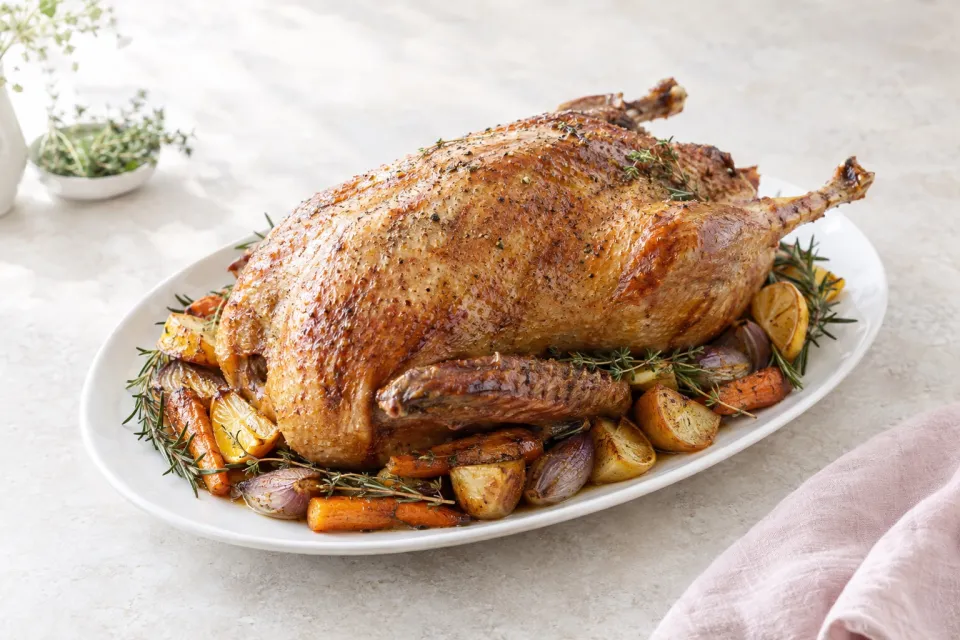
A whole roasted goose with crisped skin, Madeira gravy, and root vegetables makes a rich, impressive centerpiece with every part put to use.
Prep 1 hr 15 min · Cook 1 hr 35 min · Total 3 hr 50 min · Makes 4 servings
Ingredients
- 1 goose, approx. 8 lbs.
- Juice of a lemon
- Salt and pepper
- 1/2 yellow onion, peeled and chopped
- 1 head garlic
- 1/2 cup Madeira wine
- 2 tablespoons flour
- 2 cups chicken stock, for gravy
- 1 teaspoon dried thyme
- Root vegetables to roast with the goose, such as carrots, parsnips, turnips, potatoes, and/or rutabagas, peeled and chopped into large chunks
Directions
- If your goose has been in the refrigerator, take it out early enough to lose its chill before roasting. Leave it sealed in the plastic until you are actually ready to begin, and set it in a pan both while it chills and while it comes to room temperature, just in case the wrapping leaks. If you are starting with a frozen goose, thaw it in the refrigerator for two days before you plan to cook.
- Handle the goose with the same care you would use for any raw poultry. Work on a separate cutting board with separate utensils so nothing else gets contaminated, wash your hands with soap often, and use paper towels for cleanup. Goose is fatty, so this is as much about avoiding greasy hands as anything else.
- Pull out the neck and giblets, including the heart, gizzard, and liver, and set them aside for the gravy. Trim away the last two joints from the wings as well, and save those for the gravy too.
- To remove the wing joints, take a thin, sharp knife, such as a boning knife, paring knife, or fillet knife, and cut along the side of the joint to release the tendons. Bend the joint backward until it gives, then trim through the remaining skin and tendons. You should not have to saw through bone. Cut away the neck skin about a half inch from the body.
- Trim the extra fat from the goose, but do not throw it away. Pull the fat from inside the cavity and place it in a bowl. Cut off the broad flaps of belly skin and fat that cover the cavity, since the goose is not being stuffed, and remove the tail as well. Put all of these trimmings into a pot with a little water, about ½ cup, and set it over low heat so the fat can slowly render.
- Using a clean needle, prick the goose skin all over so the fat beneath it has a way to escape. Hold the needle at an angle and pierce only the skin, not the meat. Take your time and cover the whole bird.
- Heat the oven to 325 degrees F.
- Rub the goose thoroughly with the cut half of a lemon, using both halves so the skin is well coated. Place the lemon halves inside the cavity.
- Season the outside generously with salt. Use a heavier hand than you might expect, since the salt helps the skin crisp and seasons the bird well. Cut the top off the head of garlic and tuck it inside the goose.
- Set the goose breast side up on a rack in a roasting pan, then place it in the oven.
- While the goose begins roasting, start the gravy. Chop the giblets, wing pieces, and neck, then brown them in a large pan with some goose fat. Season them with salt.
- Add the chopped onion and stir it in. Once the onion has taken on a little color, scatter the flour into the pan and mix well. Cook over medium heat, stirring frequently, until the mixture smells toasty and nutty, about 5-10 minutes. Raise the heat to high and pour in the Madeira.
- Boil the Madeira vigorously for a minute or two, then add the chicken stock and stir everything together. Add the dried thyme, then lower the heat so the gravy barely simmers.
- Once the goose has roasted for 20 minutes, add the root vegetable chunks you want to use. Tossing them first with some rendered goose fat and salt gives them a very good start before they go into the bottom of the roasting pan.
- This is also a good moment to spoon off any goose fat collecting in the roasting pan. Add that fat to the pot with the other rendering goose fat. Return the goose to the oven and roast for another 20 minutes.
- After 40 minutes total roasting time, check the temperature of the breast. It should read between 130 and 140 degrees. If it does, take the goose out of the oven, but leave the oven on.
- Carve off the whole breasts. With a thin knife, ideally a boning knife, cut where the breast meets the leg, then make another cut where the breast meets the wing.
- Cut along the keel bone that divides the breast halves. Work straight down, tapping the tip of the knife against the breastbone as you guide the blade up toward the wishbone and then back toward the open cavity.
- The keel on a goose is deep, and the breastbone angles out widely from it, so use short, careful strokes to release the entire breast half. When you reach the wishbone, locate it with the tip of the knife and cut neatly around it. Do the same thing on the other side.
- Lift off the breasts and cover them loosely with foil.
- Return the goose, now without the breasts, to the oven. Roast it for another 30 to 40 minutes.
- Check the gravy as the goose finishes. If it tightens up too much, stir in a little water.
- After 30 minutes, check the thickest part of the thigh with a thermometer. Take the goose out when it reaches 165-170 degrees F. Look at the root vegetables too; if they are tender, they can come out, and if not, leave them in the oven a little longer.
- Take the garlic out of the goose. Cover the goose loosely with foil and set it aside.
- Squeeze the garlic cloves from their skins and add the cloves to the simmering gravy. Cook for 5 minutes. Remove the neck and wing pieces, pick off any meat, and add those bits back to the gravy. Transfer the gravy to a blender and purée until completely smooth, working in batches so hot gravy does not surge out of the blender. The gravy should be thick; add water if it is too thick, and if it is too thin, it can be simmered down.
- Pour the gravy back into the pot and keep it over low heat. If it needs to thicken, let it simmer longer.
- Heat a large sauté pan until hot. Add some goose fat and warm it over medium-high heat.
- Pat the goose breasts dry. They should still be pink on the meat side. Lay them in the pan skin side down and sear the skin firmly, pressing lightly if needed so the skin makes good contact with the pan. Check after 3-4 minutes; you are looking for a deep brown color.
- When the skin is ready, remove the breasts without cooking the meat side, and salt the skin right away. Set them aside with the skin facing up, and take the pan off the heat.
- Carve the legs and wings from the goose.
- Heat the pan again and sear the skin side of the legs and wings. While they sear, slice the breast skin side up, on an angle if you like. Salt the legs and wings and serve them with the root vegetables.
- Because you worked for that crisp skin, spoon the gravy under the goose rather than over the top.
- When the goose is finished, save the carcass bones for goose stock, made just the way you would make chicken stock, but with goose bones.