Kneadlessly Simple's English Muffin Loaves
A no-knead English muffin-style bread with a cornmeal crust and sturdy crumb, made for slicing, toasting and buttering generously.
Prep 25 min · Cook 1 hr · Total 19 hr 40 min · Makes 2 loaves
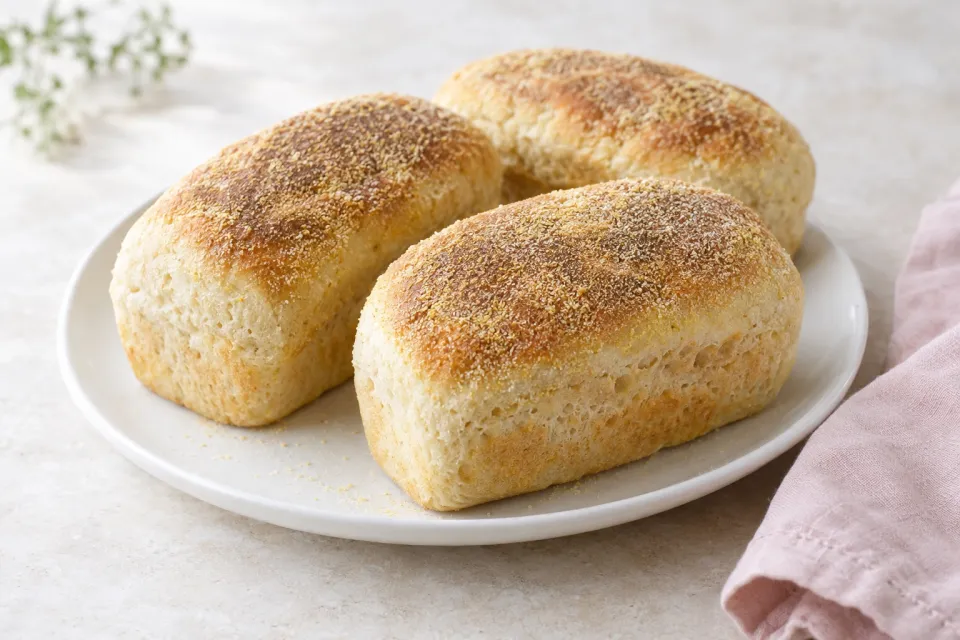
Ingredients
- 5 cups unbleached all purpose white flour, plus more as needed
- 1 tablespoon granulated sugar
- 2 teaspoons table salt
- 1 teaspoon instant, fast-rising, or bread machine yeast
- 2 1/2 tablespoons corn oil or other flavorless vegetable oil, plus extra for coating dough top and baking pans
- 2 2/3 cups ice water, plus more if needed
- 1/3 cup top-quality instant nonfat powdered milk
- About 2 tablespoons cornmeal for coating pans
Directions
- For the first rise, combine the flour, sugar, salt, and yeast in a very large bowl, stirring until everything is evenly distributed. In a separate bowl or measuring cup, whisk the oil with the ice water. Pour the ice-water mixture into the dry ingredients and stir with energy, scraping the sides of the bowl well, until you have a fully combined dough. If the mixture is too dry to come together, add only enough extra ice water to incorporate the ingredients; stop before it gets loose, because this dough should stay fairly firm. If it needs tightening, work in additional flour. Oil the top of the dough with a brush or spray, then seal the bowl tightly with plastic wrap. For deeper flavor or a more flexible schedule, refrigerate the dough for 3 to 10 hours if you like. After that, leave it to rise at cool room temperature for 12 to 18 hours; if it fits your timing, stir it vigorously once while it rises.
- For the second rise, beat the powdered milk into the dough with a strong stirring motion. Stir in enough additional flour to make the dough very stiff. Coat two 8 1/2 × 4 1/2-inch loaf pans generously with grease. Add the cornmeal and tilt the pans around so the coating is even. With well-oiled kitchen shears or a serrated knife, divide the dough in half, then transfer each piece to a prepared pan. Oil the tops with a brush or spray, and use an oiled rubber spatula or your fingertips to level the surface and push the dough evenly into the pans. Cover the pans snugly with plastic wrap that has been coated with nonstick spray.
- Choose one rising method: for a 1 1/2- to 2 1/2-hour regular rise, leave the pans at warm room temperature; for a 1- to 2-hour faster rise, place them in a turned-off microwave with 1 cup of boiling-hot water; or for a longer rise, keep them covered in the refrigerator for 4 to 24 hours, then bring them out to room temperature. Let the dough rise until it is close to the plastic, then take the plastic off and let it continue rising until it just comes up to the rims of the pans.
- For the baking setup, 15 minutes before you plan to bake, position a rack in the lower third of the oven and heat the oven to 400ºF. Lightly spritz or brush the tops of the loaves with water.
- To bake, turn the oven down to 375ºF. Set the pans on the lower rack and bake for 30 to 40 minutes, until the tops are deeply browned. Tent the loaves with foil and bake for another 10 to 20 minutes, until a skewer pushed into the thickest area has only a few crumbs clinging to the end, or the centers read 208º to 210ºF on an instant-read thermometer. Bake for 5 to 10 minutes more so the middles are fully done. Let the loaves cool in their pans on a wire rack for 10 to 15 minutes. Turn the breads out onto the rack and let them cool completely.
- For serving and storing, wait until the loaves are completely cool before cutting or putting them away. Toast the slices before serving. Wrap the bread in plastic or aluminum foil. It will keep at room temperature for 3 days, and it can be frozen airtight for up to 2 months.