Pie Dough the Old-Fashioned Way
A simple hand-mixed pie dough with cold butter layers, built for crisp, flaky crusts without special tools.
Prep 25 min · Total 2 hr 25 min · Makes 2 9-inch pie crusts or 1 double-crust pie
Ingredients
- 8 ounces low protein all-purpose flour, such as Gold Medal Blue Label, plus more for dusting
- 1/2 ounce sugar
- 1 teaspoon Diamond Crystal kosher salt; for table salt, use half as much by volume or use the same weight
- 8 ounces unsalted, American-style butter, straight from the fridge, cold
- 4 ounces cold tap water
Directions
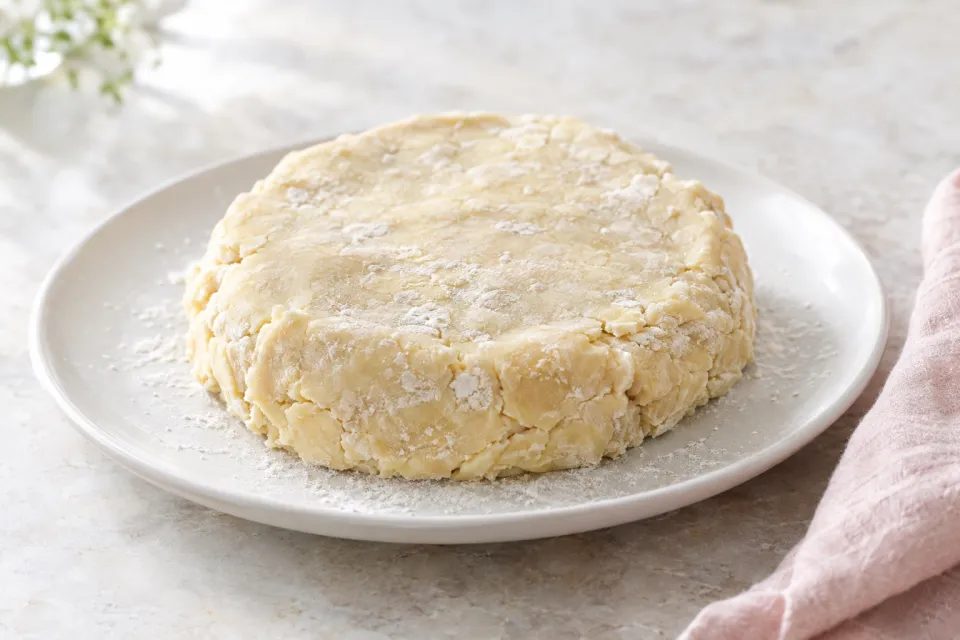
- For the dough, combine the flour, sugar, and salt in a medium bowl with a whisk. Cut the cold butter into cubes, making sure they are no smaller than 1/2-inch, then add them to the flour mixture and toss to separate them. Press every cube flat with your fingertips, and stop there, no rubbing in, no cutting down further. Add the water and stir, then press and knead the dough against the bowl until it gathers into a rough, shaggy ball. Check the dough temperature; it should be 65 to 70 degrees F (18 to 21 degrees C). If it is outside that range, chill it briefly before you move on to rolling and folding.
- To build the layers, flour your work surface generously and roll the dough into an approximate 10- by 15-inch rectangle. Bring the 10-inch edges in toward the middle, then fold the packet closed like a book. Fold it in half again, matching the short ends, so you have a compact, thick block. Cut the dough in half with a sharp knife or bench scraper. The dough should still be in the 65 to 70 degrees F (18 to 21 degrees C) range; if it is not, give it a short rest in the refrigerator before continuing.
- For single-crusted pies, use as much flour as you need and roll one portion into a 14-inch round. That size gives you enough dough to fit the pie plate and still have extra for a substantial edge; if you roll it smaller, there will not be enough dough for shaping, and the thicker crust will not crisp properly. Move the dough to a 9-inch pie plate; it should be manageable without any special transfer method. Brush away extra flour with a pastry brush, and use the brush to help ease the dough into the corners of the pan. Trim the dough with scissors or kitchen shears so it extends 1 1/4 inches past the rim all the way around. Turn that extra dough under itself to make a thick rim that rests on the top edge of the pie plate rather than below it. Crimp or shape the edge however you like. Do the same with the remaining dough. Cover with plastic and chill for at least 2 hours or as long as overnight. Use the prepared crusts as needed in your chosen recipe.
- For a double-crusted pie, flour as needed and roll one dough portion into a 14-inch round. This gives enough dough to line the pie plate with extra for a good border; rolled any smaller, it will be hard to seal the pie neatly, and the thicker dough will not crisp the way it should. Place the dough in a 9-inch pie plate; it should lift and move without any special tricks. Sweep off extra flour with a pastry brush, using the brush to settle the dough into the corners of the pan. Trim with scissors or kitchen shears, leaving 1 1/4 inches of dough beyond the rim on every side. If you want a full top crust, roll the second piece the same way; for a lattice, roll it into a 9- by 15-inch rectangle. Move that top crust to a baking sheet or to a parchment-lined cutting board. The parchment helps keep the dough from picking up savory odors from the board. Wrap both pieces in plastic and refrigerate for at least 2 hours or up to overnight. Use as your recipe directs; once the pie is filled and the crusts are sealed, chill it for 30 minutes before baking.
- For a blind-baked pie, set a rack in the lower-middle of the oven and heat to 350 degrees F (180 degrees C). Take a pie shell that has already chilled for at least 2 hours as described for a single-crust pie, and line it with a large piece of aluminum foil, pressing the foil into the curves of the plate. If one piece does not cover everything, use another sheet of aluminum. Fill the shell completely with sugar, set it on a half sheet pan, and bake until the crust is firm and the edges are golden, 60 to 75 minutes. Bring the long edges of the foil in toward the center, gather the short ends, and carefully lift the sugar into a heat-safe bowl with both hands. Cool the sugar to room temperature. If the bottom still needs more color, return the crust to the oven for a few more minutes.