Prime Rib
A simple salt-and-pepper standing rib roast with rich pan gravy, cooked low after a hot sear for tender, sliceable beef.
Prep 30 min · Cook 2 hr 10 min · Total 6 hr 10 min · Makes 6 to 21 servings
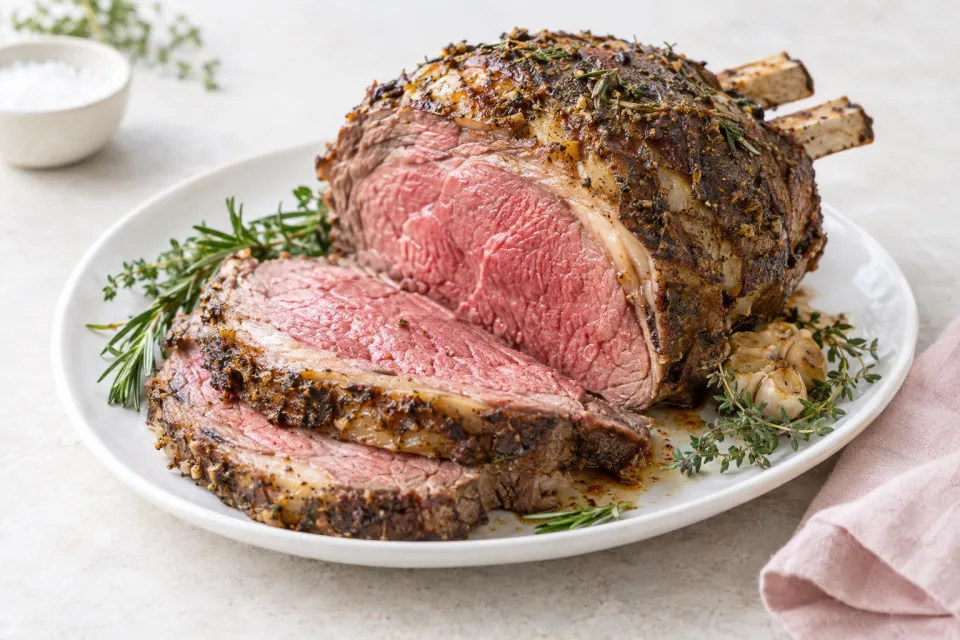
Ingredients
- One standing rib roast, 3 to 7 ribs, bones cut away from the roast and tied back to the roast with kitchen string
- Salt
- Freshly ground black pepper
Directions
- Take the beef roast out of the refrigerator 3 hours before cooking. Season it generously with salt on every side, then leave it loosely covered in the butcher paper while it comes closer to room temperature, which helps it cook more evenly.
- If the butcher has not prepared it already, slice the rib bones off the roast and secure them back in place with kitchen string. You will still be able to roast the beef standing on the bones, but carving later will be much simpler.
- Heat the oven to 500 degrees F, or to the hottest setting your oven allows if it does not reach 500 degrees F. Blot the roast well with paper towels, since the salt will have drawn out some moisture, then season the entire surface with salt and pepper.
- Set the roast in a roasting pan with the fat facing up and the rib bones underneath. Slide an ovenproof meat thermometer into the thickest section of the meat, taking care that the tip does not touch bone.
- Put the roast in the oven and let it brown at 500 degrees F for 15 minutes.
- Turn the oven down to 325 degrees F. For a rough estimate of the full roasting time, plan on about 11-12 minutes per pound for rare, or 13-15 minutes per pound for medium rare.
- The exact timing depends on the shape of the roast, how cold it still is when it goes into the oven, and how your oven runs. A broad, flatter roast will finish sooner than a thicker one, and a roast that is still quite chilled will need more time than one closer to room temperature.
- Because those variables matter so much, use a meat thermometer rather than guessing. Prime rib is not the place to improvise wildly. If you are unsure, lean toward rare; you can always return the roast to the oven if it needs more time.
- Continue roasting until the thermometer reads 115 degrees F for rare, or 120 degrees -130 degrees F for medium. The temperature inside the meat will keep rising after the roast comes out of the oven.
- Start checking the roast with a meat thermometer an hour before you think it will be finished. For example, a 10 pound roast cooked rare should take about 2 hours total, including 15 minutes at 500 degrees and 1 3/4 hours at 325 degrees. For that roast, begin checking at 1 hour 15 minutes total cooking time, or 1 hour after lowering the oven to 325 degrees. If you are using a remote thermometer, you can watch the temperature from outside the oven instead of opening the door repeatedly.
- If the roast is moving along too fast, reduce the oven temperature to 200 degrees F.
- When the roast reaches your preferred temperature, transfer it from the oven to a carving board. Tent it with foil and rest it for 30 minutes before slicing; the internal temperature will continue to rise during this time.
- Snip off the strings holding the roast to the rib bones. Lift away the bones, saving them for stock or soup if you like.
- With a sharp carving knife, cut the meat across the grain into slices about 1/2-inch to 3/4-inch thick.
- To make the gravy, take the roast out of the pan. Spoon off extra fat, leaving 1/4 cup of fat along with the browned bits and meat juices in the roasting pan.
- Set the roasting pan over medium high heat on the stovetop. Scrape the bottom with a metal spatula to loosen any drippings stuck to the pan.
- Once the fat is bubbling, scatter 1/4 cup of flour over the fat and drippings.
- Whisk the flour into the fat until smooth, then allow the flour to brown so the gravy has better flavor and no raw flour taste.
- Gradually pour in 3 to 4 cups of water, milk, stock, or beer, whisking the whole time and breaking up any lumps of flour as you go.
- Let the gravy simmer and thicken slowly; you should end up with about 2 cups of gravy. If you would rather make less, begin with less fat and flour and use less liquid.
- Season the gravy with salt, pepper, and herbs to taste.