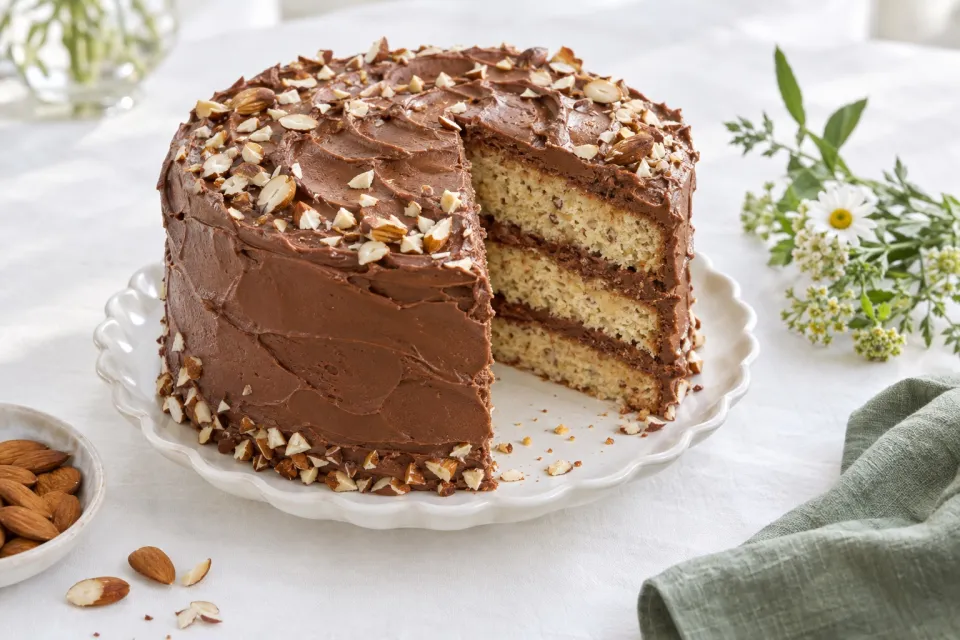
Fluffy and Nutty Almond Layer Cake
A soft almond layer cake with milk, butter, and extracts for a tender, fragrant crumb that pairs beautifully with chocolate buttercream.
Prep 1 hr 5 min · Cook 35 min · Total 3 hr 40 min · Makes 1 8-inch layer cake (16 slices)
Ingredients
- For the cake:
- 11 1/4 ounces all-purpose flour
- 6 ounces almond flour, see note
- 15 ounces plain or lightly toasted sugar
- 4 teaspoons baking powder
- 2 teaspoons Diamond Crystal kosher salt; for table salt, use about half as much by volume or the same weight
- 8 ounces unsalted butter, soft but cool, about 60°F
- 3 large eggs, brought to about 65°F
- 1/2 ounce vanilla extract
- 1/2 ounce pure almond extract, more or less to taste
- 1/4 ounce rose water, optional
- 15 ounces whole milk, brought to about 65°F
- To Finish:
- 1 recipe Chocolate Swiss Buttercream or a double batch of American-Style Chocolate Buttercream
Directions
- Set an oven rack in the lower-middle spot and heat the oven to 350 degrees F (180 degrees C). Grease 3 8-inch anodized aluminum cake pans lightly, then add parchment liners. If you only have fewer pans, bake in batches; the batter can wait at room temperature until its turn. Sift the all-purpose flour with the almond flour into a bowl, then whisk them together very well for at least 1 minute, since poorly blended flours can leave the cake with an uneven texture and patchy exterior.
- For the cake, add the sugar, baking powder, salt, and butter to the bowl of a stand mixer fitted with the paddle attachment. Start on low just until the mixture begins to come together, then turn the mixer to medium. Beat until the mixture turns pale, airy, and fluffy, about 8 minutes, stopping around the midpoint to scrape down both the bowl and paddle with a flexible spatula.
- While the mixer runs, add the eggs 1 at a time, waiting until each egg disappears into the batter before adding the next. Mix in the vanilla extract, almond extract, and rose water, if using. Turn the speed down to low, add about 1/3 of the almond-flour mixture, then pour in 1/3 of the milk. Continue alternating the remaining flour mixture and milk in 1/3 portions the same way.
- Use a flexible spatula to scrape the bowl and paddle, then mix again on medium for about 3 seconds so the batter is fully unified. It should be thick and creamy, with a temperature of 65 to 68 degrees F (18 to 20 degrees C) on a digital thermometer. If it is much warmer or cooler, the ingredients were likely off-temperature, which may affect the cake’s texture.
- With a flexible spatula, lift and fold the batter from the bottom once or twice, then portion it evenly into the prepared pans, about 20 ounces/565g in each. Arrange the pans staggered on the oven rack and bake until the layers have risen, feel set, and show a little browning at the edges while staying fairly light on top, about 35 minutes. If your oven heats unevenly, rotate the pans after about 20 minutes. You can also bake two layers first and bake the third after those come out.
- Leave the cakes in their pans to cool for 1 hour. Slide a butter knife around the sides to release them, turn them out onto a wire rack, remove the parchment, and flip the layers upright again. If wrapped in plastic, the cakes may sit at room temperature for a few hours. Make whichever frosting you’re using.
- For the crumb coat, trim the cakes level with a serrated knife and save the scraps for snacking. Set 1 layer on a heavy cast iron turntable. If desired, place a waxed cardboard cake round beneath it first, anchoring it to the turntable with a piece of damp paper towel. Spread exactly 1 cup buttercream over the top with an offset spatula, carrying it evenly to the edges. Add the 2nd and 3rd layers the same way, then coat the sides with another cup of buttercream, smoothing it as neatly as you can. Chill the cake until the buttercream is firm, about 30 minutes.
- To finish, whip the remaining buttercream again so it becomes creamy, then frost and decorate the cold cake however you like. If desired, add toasted sliced or slivered almonds. Before slicing, let the cake reach an internal temperature of at least 70 degrees F (21 degrees C), then cut portions with a chef’s knife, cleaning the blade between slices. Spread extra buttercream over any cut surfaces to help protect the cake from drying out. Stored beneath a cake dome, it will hold for 3 days in a cool room.