No-Bake Greek Yogurt Cheesecake
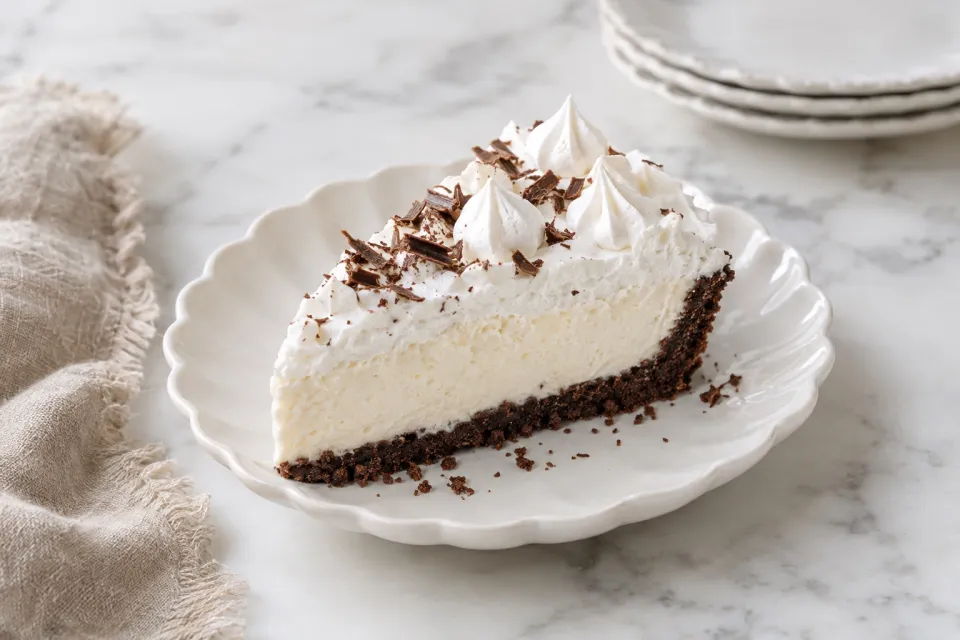
A chilled chocolate-crust cheesecake with tangy Greek yogurt, whipped cream, and meringue for a light, creamy no-bake slice.
Prep 35 min · Cook 15 min · Total 6 hr 50 min · Makes 10 servings
Ingredients
- Getting Ready:
- Cooking spray, for greasing the pan
- For the crust:
- 8 3/4 ounces chocolate cookie crumbs
- 2 ounces unsalted butter, melted and very warm
- 1/8 teaspoon Diamond Crystal kosher salt; for table salt, use about half as much by volume or the same weight
- For the filling:
- 1/2 ounce unflavored gelatin powder, such as NOW Foods
- 1 ounce water, milk, or cream
- 3/4 ounce vanilla extract, or more to taste
- 24 ounces strained Greek yogurt, such as Fage or Chobani, or skyr such as Siggi's
- 12 ounces heavy cream
- 6 ounces egg whites from about 6 large eggs
- 7 ounces sugar
- 1/2 teaspoon Diamond Crystal kosher salt; for table salt, use about half as much by volume or the same weight, or more to taste
- To Serve:
- Chocolate shavings, sprinkles, or candies, such as Valrhona Crunchy Pearls, Callebaut Crispearls, malt balls, etc
Directions
- Getting Ready: You’ll need an 8- by 4-inch nonreactive aluminum pan for this recipe; a loose-bottom pan is ideal, but a springform pan with comparable dimensions can work if you handle it gently. Before you begin building the cheesecake, cover the bottom insert with foil and trim off the extra so the pan can rest evenly. Coat the pan lightly with cooking spray.
- For the Crust: Put the cookie crumbs, melted butter, and salt directly into the prepared pan. Use a fork, or just your fingers, to mix everything until the crumbs are evenly moistened. Taste and add more salt if needed. Press the mixture firmly and evenly across the bottom of the pan with your fingertips or the base of a small glass.
- For the Filling: In a small bowl, use a fork to blend the gelatin powder, water, and vanilla until smooth and evenly mixed. At the same time, add the Greek yogurt and cream to the bowl of a stand mixer fitted with the whisk attachment, then beat until the mixture thickens enough to make medium-stiff peaks, about 5 minutes; the exact timing depends on your mixer and how much moisture is in the Greek yogurt. Spoon the whipped mixture into another container, cover it, and chill until you need it, up to 1 hour. Before moving on, be sure the mixer bowl and whisk are absolutely clean, since even a little fat can keep the meringue from whipping properly.
- For a Stand Mixer With a Bowl-Lift Design: Pull off a long piece of foil and scrunch it into a sturdy ring. Set the ring inside a 3-quart saucier, or another wide pot of similar size, then add roughly 1 1/2 inches water. Heat over high until the water is steaming and bubbling, then lower the heat so it stays at a gentle simmer. In a stainless steel stand mixer bowl, stir together the egg whites, sugar, and salt. Nestle the bowl over the steam so it sits on the foil ring without touching the water or the pot. Cook while constantly stirring and scraping with a flexible spatula, until a digital thermometer reads 175 degrees F (79 degrees C) in the egg whites; plan on 8 to 10 minutes at most. Move the bowl to the stand mixer and attach the whisk.
- For a Stand Mixer With a Tilt-Head Design: Add a few inches of water to a large pot and bring it to a bubbling-hot point over high heat. Combine the egg whites, sugar, and salt in a large heatproof glass or ceramic bowl. Position the bowl above the steaming water, then cook the mixture, scraping and stirring nonstop with a flexible spatula, until the egg whites reach 175 degrees F (79 degrees C) on a digital thermometer; this should stay under 10 minutes. Transfer the mixture into the stand mixer bowl, then set up the mixer with the whisk attachment.
- Beat the meringue on high speed until it looks shiny, thick, and firm, while still feeling warm, about 4 minutes. Use the texture as your real guide, because the timing can shift quite a bit. Toward the end, warm the prepared gelatin until melted, using short, careful 10-second bursts in the microwave or the water bath. However you melt it, the gelatin should be fluid and warm, but not above 212 degrees F.
- Scoop about 1/3 of the warm meringue into a large bowl. Working quickly with a balloon whisk, blend in the warm gelatin before it can firm up against the bowl. Whisk in the rest of the meringue, then fold in the whipped Greek yogurt in 2 or 3 additions. Taste and adjust with more salt or any extracts you like. Scrape the filling into the prepared pan right away and spread it level. Cover with foil and chill until the cheesecake is completely set and the center is no warmer than 40 degrees F (4 degrees C), at least 6 hours.
- Unmolding the Cheesecake: Run a thin knife or offset spatula around the edge to release the cheesecake from the pan. Set the pan on a large can of tomatoes, or something similar, choosing a base that is steady and tall enough to raise the cheesecake 4 inches off the counter. Hold the sides of the pan with both hands and pull down so the outer ring slips away from the base. Set the cheesecake on a flat surface, slide an offset spatula underneath to release it from the pan bottom, and move it to a large, flat serving plate. Cover well with plastic wrap and refrigerate until needed, up to 1 week.
- To Serve: Add your toppings as desired. Slice with a large chef’s knife warmed in hot water; for neater pieces, rinse the knife under hot running water between cuts. Serve chilled.
- Troubleshooting: The water-bath times are only estimates, and every kitchen is a little different, but a major timing difference usually means the heat is much too high or too low. If the meringue heats too quickly, the egg whites can scramble even with careful scraping, leaving the filling lumpy and eggy. If it warms too slowly, too much moisture can evaporate, and the meringue may turn dense and grainy. Adjusting the heat will fix the problem.